Hunting Island State Park Camping: Hookup Sites, Tent Area, Group Camp
Choosing a campsite at Hunting Island means matching your group to the right kind of stay: a standard site with hookups, a designated walk-in tent area, or a primitive group camp. The options suit different rigs and levels of self-sufficiency. This guide explains what each setup means, what to verify before booking, and how to plan a coastal camping trip without assuming amenities or rules that may not apply.
How camping is arranged at Hunting Island
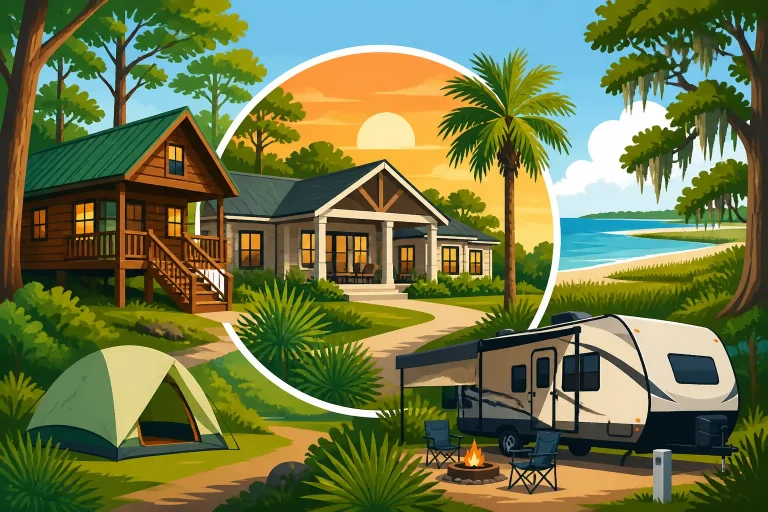
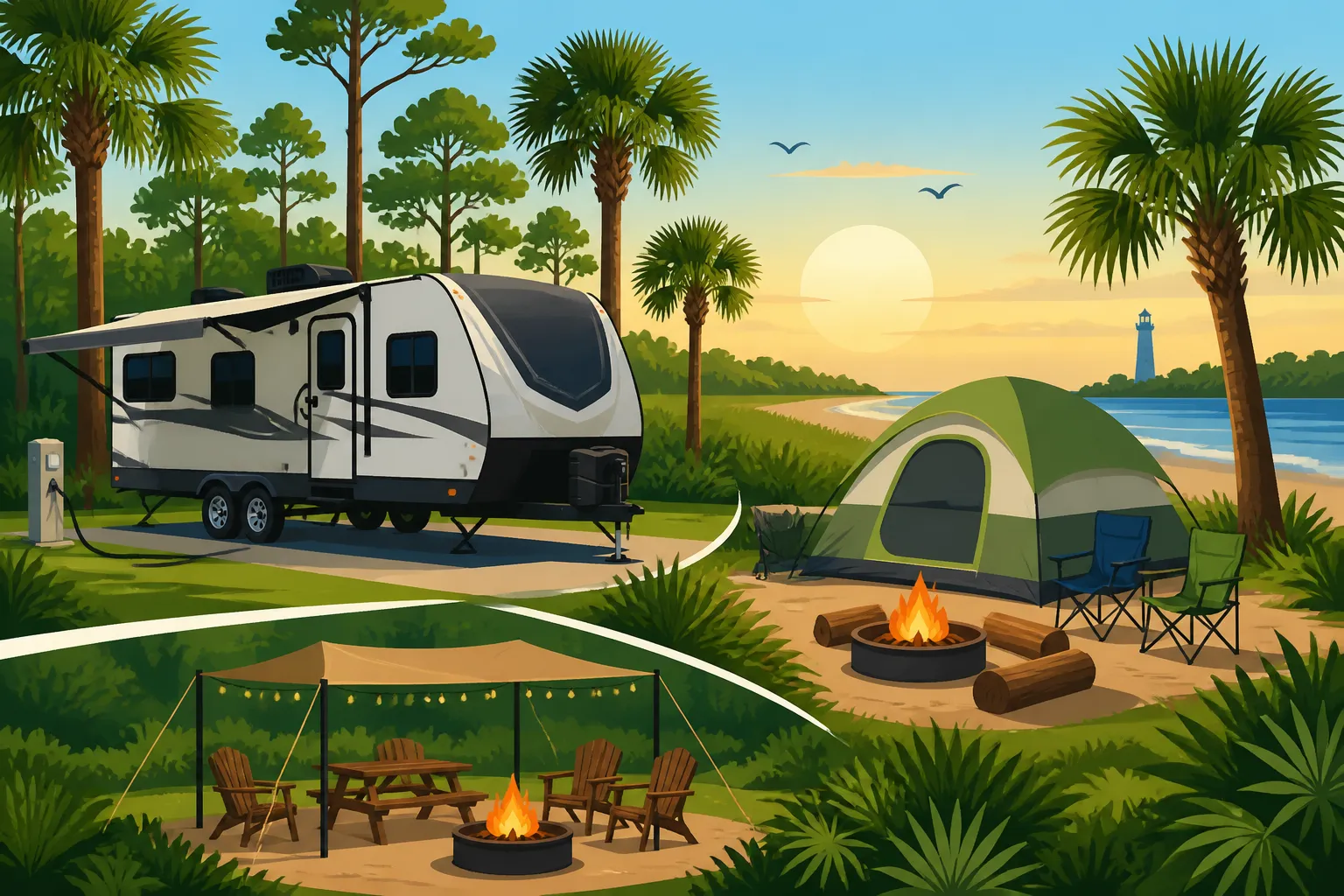
According to the South Carolina Department of Parks, Recreation and Tourism, two campgrounds are located at the northern end of the park. The department describes the camping choices as standard campsites for tent campers and RVs, a designated walk-in tent area, and a primitive group camping area for organized groups.
That range gives you a useful starting point, but the labels matter. A standard site, a walk-in tent site, and a primitive group area are not interchangeable. They may serve different kinds of equipment and groups, and they should not be treated as offering the same services. The right fit depends on what you are bringing, how much convenience you need, and whether you are traveling as an individual party or an organized group.
The coastal setting is part of the appeal, but it also makes practical planning important. Before settling on a site, check the current official park information for availability, site details, fees, arrival instructions, and any changes to operations. Details shown for one campsite type should not be assumed to apply to another. If an online listing does not answer a key question, contact the park through its official channels rather than relying on a description of a different site or a visitor’s older account.
A helpful way to compare the options is to start with the trip’s basic needs:
| Camping option | Best starting point for | What to verify before choosing |
|---|---|---|
| Standard campsite | Tent campers or RV travelers who want a conventional campsite | The specific site’s hookup details, size, equipment limits, and current availability |
| Designated walk-in tent area | Tent campers who are prepared to carry gear from the parking area | The route from parking, what the site provides, and what water or other services are available |
| Primitive group camping area | Organized groups planning to camp together | Eligibility, capacity, access, booking arrangements, facilities, and group requirements |
The table is a planning framework, not a promise that every site includes the same features. Details can vary by campsite and may change, so confirm them with the official park information before you make a decision.
If you are comparing campsite types across the state system, Choosing a South Carolina State Park Campsite: Tent, RV or Primitive can help you think through the trade-offs. For a broader overview of overnight options and park rules, see Camping in South Carolina State Parks: Sites, Cabins and Rules.
Standard sites with water and electrical hookups
The South Carolina Department of Parks, Recreation and Tourism says one campground provides individual water and electrical hookups. The department lists 102 sites with electric and water. That makes standard sites a natural option for travelers who want a conventional campsite and need those services at their site.
A hookup description is useful, but it is only part of the decision. If you are bringing an RV, check the specific site listing rather than assuming every site has an identical layout or supports the same equipment. Confirm the power service, whether water is available at the individual site, the site dimensions, and any vehicle or equipment limits listed by the park. If you need a sewer connection, do not infer that one is available just because water and electricity are listed. Look for an explicit answer in the official campsite details.
For RV travelers, matching the rig to the site is more than a question of whether the vehicle can physically fit. You may also need room to park a tow vehicle, open slide-outs, set out an awning, or arrange chairs and cooking gear while staying within the site boundary. Check the listed site length and the park’s instructions for the equipment you plan to use. If the listing is unclear, ask the park about the exact site you are considering. A general campground description may not settle the details for an individual reservation.
Tent campers can also consider standard sites. A hookup site is not automatically an RV-only space, but you should confirm whether the specific listing accepts the kind of tent setup you plan to bring. Think about how many tents you need, their footprint, and whether your party will bring a vehicle or additional gear. Do not assume that the presence of hookups means you can pitch tents anywhere around a site; follow the park’s site description and posted directions.
The phrase “electric and water” also does not tell you everything you need to know about power use. If you plan to run an appliance, check that its requirements fit the listed service. A heater, air conditioner, or other high-draw device may need more power than a small charging setup. The park’s listing is the place to confirm the available service, while the appliance label or manufacturer’s instructions tell you what the appliance needs. Matching Your Rig’s Power Needs to a State Park Campsite offers a useful way to approach that comparison.
Before you finalize your choice, make a short list of must-haves and nice-to-haves. For example, you might require water at the site but simply prefer a particular orientation or location. This keeps an appealing campsite from distracting you from a feature that is essential to your setup. If a site’s description does not confirm a must-have, treat it as unconfirmed rather than assuming it is included.
Also distinguish between services at a campsite and services elsewhere in a campground. A facility available somewhere in the campground is not necessarily at your site. The same goes for amenities elsewhere in the park: their presence does not establish that they are close to your campsite, open during your stay, or included in the same way for every visitor. Check the official description for the exact site and confirm any detail that affects your trip.
For a more comfortable arrival, prepare the rig before you reach the campground. Know the general dimensions of your vehicle and any attached equipment, keep the reservation details accessible, and decide who will guide the driver if backing into a site is needed. These are practical preparations, not substitutes for checking site access or restrictions with the park. If you are traveling in an unfamiliar vehicle or towing setup, review Will Your RV Fit a South Carolina State Park Campsite? before you commit to a site.
The designated walk-in tent area
The South Carolina Department of Parks, Recreation and Tourism identifies 25 sites as designated tent sites. The walk-in label is the detail to pay close attention to: it signals that you should plan for some separation between parking and the tent area, rather than expecting to pull your vehicle directly onto every tent site.
That changes what you bring and how you pack it. A tent, sleeping bags, food, water, cooking items, and camp chairs can become awkward to move when they are all carried at once. Pack in manageable loads and consider bags or containers that are comfortable to carry. Keep items you will need first easy to reach, such as a light, rain protection, and the parts of your shelter you need to get it pitched. The exact walk and carrying arrangement should be checked in the official site information, because “walk-in” alone does not tell you the route, surface, or distance.
Do not choose a walk-in site based only on the idea that it is quieter or more secluded. Those qualities can vary, and they are not guaranteed by the site type. Instead, focus on the practical fit: can everyone in your party manage the walk with the gear you intend to carry? Will you need to make more than one trip? Does anyone need a particular accessibility feature? The park’s site description can help answer the logistical questions, and the park can clarify details that the listing does not explain.
The same caution applies to water and power. A designated tent site should not be assumed to have individual hookups just because another campground area does. Check the tent-area listing for the services it actually describes, and plan for any needs that are not confirmed. If you are relying on a particular source of drinking water, ask whether it is available for your site and during your stay. Bring a backup plan for essentials when an amenity is not explicitly confirmed.
Think through your tent footprint before reserving. Some tents need more room than their sleeping capacity suggests once the vestibule, stakes, and guy lines are included. If your party uses more than one tent, verify that the site’s rules and layout allow your plan. Do not assume you can spread equipment into nearby open space. The site description and park directions take priority over a visual impression of unused ground.
A walk-in site can be a good fit for campers who want a tent-focused stay and are willing to carry their equipment. It may be a poor choice if carrying gear is difficult, if you need immediate vehicle access, or if your setup includes bulky equipment. For some groups, a standard campsite that accepts tents may be easier even if they do not need electrical service. Compare the actual site descriptions rather than deciding from the category name alone.
Pack for the kind of access the listing describes. Use containers that close securely, avoid taking more gear than your group can carry, and make sure everyone knows which items are in each bag. If you arrive in poor weather or have to manage gear while also supervising children, a simpler packing plan can make setup less stressful. Keep essential medications and personal items with you rather than buried in a load of shared equipment.
A walk-in label should also prompt you to think about arrival timing. If you expect to arrive near the end of the day, carrying and organizing gear in low light may be harder. Confirm the park’s arrival directions and check-in expectations before leaving home. Do not assume that a walk-in tent area uses the same arrival procedure as a drive-up site. Arrival and Departure Times at South Carolina Campgrounds, Explained can help you identify the kinds of timing details to confirm.
For more on choosing tent sites across the state, read Tent Camping at South Carolina State Parks: Pads, Water, Walk-In Areas. The useful lesson is to compare access, site surface, included services, and the amount of gear you can comfortably carry—not just the word “tent” in the listing.
Primitive group camping for organized groups
The South Carolina Department of Parks, Recreation and Tourism says a primitive group camping area is available for organized groups. That description points to a different kind of trip from booking a standard campsite for a family or small party. If you are arranging a group outing, confirm that your group meets the park’s definition of an organized group and that the area is available for the purpose you have in mind.
“Primitive” is a reason to check details, not a complete amenity list. It does not tell you exactly what facilities are present, how far the area is from parking, whether water is available, or what cooking arrangements are permitted. Find answers from the official park listing or by contacting the park directly. Avoid building a group plan around facilities that are not specifically confirmed.
Start with the group’s basic requirements. How many people are expected? How many tents and vehicles will you bring? Does anyone need an accessible route or particular accommodation? What food-storage, restroom, drinking-water, and waste plans will the group need? These questions are useful even when the answers depend on park rules. They help identify what you must verify before the group commits to dates or begins collecting contributions.
Make one person responsible for communicating with the park and sharing the answers with the group. A common source of confusion is different people relying on different assumptions about access, capacity, or facilities. Keep the official site description and any park guidance together with the reservation information, then send the same confirmed details to everyone attending. If the plan changes—such as adding another vehicle or changing the number of tents—check whether that affects the group’s arrangements rather than assuming the original approval still covers it.
An organized group should also settle its internal plan before arrival. Decide who is responsible for the itinerary, food, shared equipment, and cleanup. Ask participants to bring only what the group has agreed is needed. This reduces the chance of an overloaded campsite, duplicate supplies, or confusion about who is responsible for common gear. Keep the plan flexible enough to adapt if a service or activity is unavailable.
For outdoor safety, share practical expectations before the trip. Encourage everyone to follow posted park rules, keep personal gear contained, and avoid wandering into areas that are not part of the group’s permitted camping area. Explain how the group will handle food, trash, and weather. Do not create your own interpretation of park rules for the group; use the official directions and ask the park when something is unclear.
If you are not sure whether your club, troop, school, or other association qualifies as an organized group, ask before making plans. A group of friends traveling together may not meet the same criteria as a formally organized organization, and the wording of a campsite description does not settle that question. Group Camping at South Carolina State Parks: Booking via the Park covers questions to raise when arranging a group stay. For broader context on primitive group sites, see Which State Parks Offer Primitive Group Camping, and Who Qualifies?.
Do not assume the group area can be treated as several unrelated individual campsites. Confirm the intended use, capacity, and booking process with the park. Ask whether the group needs to provide any information in advance, whether there are specific requirements for the organizer, and what happens if the expected attendance changes. Those details are important to the plan, but they should come from the park rather than guesswork.
Choosing the right option for your trip
The most reliable way to choose is to begin with the equipment and access needs you cannot change. If you need individual water and electrical service, focus on the standard campground description and confirm the individual site’s details. If you are camping with a tent and can carry your gear, compare the walk-in tent area with standard sites that accept tents. If you are organizing a group, contact the park to confirm whether the primitive group area fits your group and plans.
Use a decision sequence rather than starting with a favorite site photo:
- Identify your camping equipment. List the type of tent, RV, trailer, or other setup you plan to use. Include any tow vehicle or extra equipment that affects the space you need.
- Name the non-negotiable services. Decide whether you require power or water at the site, and whether you can manage without any service that is not confirmed.
- Check access. Find out whether the site is drive-up or walk-in and what the route means for your gear and companions.
- Confirm fit. Compare your setup with the listed dimensions, permitted equipment, and occupancy information.
- Check the current official details. Confirm availability, cost, arrival instructions, and any relevant park alerts before traveling.
- Resolve open questions. If the listing leaves a detail ambiguous, ask the park before making a commitment.
That sequence reduces the risk of reserving a site that looks right but does not work for your actual setup. It also helps you separate preferences from requirements. A view, shade, or sense of privacy may influence your choice, but a site’s access and services can matter more to whether the stay is workable.
Be especially careful when a reservation page uses broad category names. A listing labeled as a standard campsite may not tell you whether the exact site is suitable for your rig or tent layout. A tent-area label does not tell you whether the route is manageable for everyone in your party. A primitive group description does not answer eligibility or capacity questions. Use the category to narrow your choices, then verify the individual details.
If your travel dates are flexible, compare availability across the options rather than deciding that one type is the only possible fit. If your dates are fixed, identify acceptable alternatives in advance. For example, a tent camper might be able to use either a designated tent site or a standard site that permits tents, depending on the official listing. An RV traveler should identify another suitable standard site rather than assume that any open site can accommodate the vehicle.
Check the current fee and cancellation information before completing a reservation. Costs and terms are set by the park system and may vary with site type or other conditions; use the official source for current figures. Do not rely on an old screenshot, a copied itinerary, or a price remembered from a previous trip. If the cost or cancellation rule is not clear, confirm it before submitting payment.
The same principle applies to changes and cancellations. Read the terms attached to the booking and keep the confirmation. If you need to change your plans, use the official reservation channel and check what options and deadlines apply to that booking. Do not assume an informal message or an uncompleted change request has altered the reservation.
For a coastal trip that includes other parks or different campsite styles, Coastal State Parks in South Carolina for Campers and Cabin Renters can help with regional planning. If you are deciding whether your trip should be an overnight stay or a day visit, Visiting South Carolina State Parks Without Camping: A Day-Trip Guide offers a different planning perspective.
What to confirm before you leave
A little verification before departure can prevent a campsite mismatch. Start with the official Hunting Island camping information and the details for the specific site or area you intend to use. Confirm the reservation, the site type, what services are provided, and any equipment or occupancy requirements shown. If the information is incomplete, ask the park directly.
Use a simple pre-trip checklist:
- Confirm the site category and the location described in your reservation.
- Verify whether water and electrical hookups are individual to the site.
- Check the site’s listed dimensions and whether your equipment is permitted.
- For a walk-in tent site, confirm the access arrangement and plan how you will carry gear.
- For a group stay, confirm eligibility, capacity, booking details, and facilities with the park.
- Review the current cost, payment, cancellation, and change terms.
- Check arrival and departure instructions, including any check-in requirements.
- Look for current park alerts, closures, or service changes before leaving and again as your plans require.
- Save the official confirmation and park guidance where the trip organizer can access them.
The confirmation should be specific enough for the person driving and the person setting up. If someone else in the group is handling arrival, share the site information with them in advance. Do not rely on a single traveler to remember every detail after a long drive.
Check for service changes close to departure. A page you viewed when planning may not show a later closure or temporary change. Park Alerts and Closures: Checking a State Park Before You Drive explains why checking the latest information is part of the trip plan. For campsite-specific changes, use the park’s official communications or contact the park.
Think through food, trash, and cooking before you pack. The correct approach depends on park rules and the facilities available at your site. Follow posted directions, store food and scented items as required, and use designated areas for waste. If the official information does not answer a question about food storage or cooking equipment, ask rather than making assumptions from another campground’s rules.
Fire information deserves a separate check. Fire rules and restrictions can change, and the requirements for a campground or specific cooking setup may differ from what you expect. Check the appropriate official information before leaving and again when you arrive. Do not count on a restriction remaining unchanged between planning and your stay. Campfire Questions to Ask at State Park Check-In is a useful prompt for identifying what to verify.
Prepare for weather and coastal conditions without assuming the park will provide specific equipment or services. Pack clothing and shelter appropriate to the forecast, secure loose items, and protect supplies that could be damaged by moisture. If a forecast changes, reconsider whether your tent, vehicle, or group plan still works. Check the park’s current alerts for operational information rather than assuming that a planned activity or facility will be available.
At arrival, compare the site you are directed to with your reservation information. If something does not match—such as the site type or a service you were told to expect—pause and ask park staff before setting up. Do not move to an unassigned site because it appears vacant. A campsite that looks open may be reserved or unavailable, and the park’s instructions determine where you should stay.
After setup, keep the site organized and follow the posted rules. Put shared equipment where it will not block access, keep food and trash managed according to the park’s directions, and make sure everyone in the party knows which areas are part of the campsite. For a group, agree on a quiet and cleanup plan before the evening becomes busy. For an individual party, having the gear and waste plan settled early makes it easier to enjoy the stay rather than sorting out details as they arise.
A final check before departure is worthwhile too. Confirm the required checkout steps, pack out your belongings, and leave the site in the condition required by the park. If you notice damage or a problem that needs attention, use the park’s official contact method. The goal is a smooth handoff for the next camper and a clear record of anything that needs follow-up.
Frequently Asked Questions
Does every Hunting Island campsite have hookups?
No. The official description identifies hookups at one campground, while the park also offers a walk-in tent area and a primitive group camping area. Confirm the services for the specific site you are considering.
Can an RV use the designated tent area?
Do not assume so. Check the official listing for equipment restrictions and access details. If you are bringing an RV, choose a site whose description explicitly fits your vehicle and confirm the site dimensions.
What does “walk-in” mean for tent campers?
It means you should plan for access on foot rather than expecting to drive directly onto the tent site. Confirm the route and carrying arrangements with the official park information, then pack gear that your party can manage.
Who should consider the primitive group area?
It is described for organized groups. Ask the park whether your group qualifies and confirm capacity, access, facilities, and the booking process before organizing the trip.
What should I verify before booking?
Confirm the site type, equipment fit, services, cost, availability, and arrival instructions using current official park information. Ask the park about anything the listing does not clearly answer.
Sources
- South Carolina Department of Parks, Recreation and Tourism — Hunting Island Camping | South Carolina Parks Official Site (checked November 23, 2026)
Disclaimer
This article is for general informational purposes only and does not constitute professional advice. Laws, prices and regulations vary by location and change over time. Consult a qualified professional for guidance on your specific situation. South Carolina Camping & RV is not a government agency and is not affiliated with any government agency.